
I learned early in life that fabric was a language all its own. In preschool, I had a teacher named Miss Sita. She was an elegant woman from India who wore beautiful saris. One day after school, I went with Miss Sita, my mother (a Midwestern housewife) and my grandmother (a small German woman who wore house dresses and aprons) to a fabric store. I remember trailing behind them, mimicking them as they pinched the fabric between their fingers and talked quietly about its virtues, its possibilities. That moment helped me understand that fabric is a way to connect strangers, providing a language of safety and beauty.
Through a practice grounded in fiber art, I build assemblages and domestic sculptures out of objects that have been discarded. Sustainability plays an important role in my work. I’m equally concerned with the act of preservation. I like to think of myself as an archivist, collecting items and recontextualizing them, giving them a new life.
Each of the chosen objects, fabrics or pieces of clothing has a soul -- having been used or worn by someone, lived in and animated by the previous owner. My assemblages and domestic sculptures are fashioned out of objects that speak to me - old suitcases, unfinished hand-stitched pillows, a child’s dress from the turn of the century. I may begin with a personal item that has outlived its use in my life -- such as an old nightgown, a sweater of my mother’s wedding dress. I then add scraps of piecework - - domestic crafts that have outlived their usefulness and are filled with unrepairable holes. In this way, the work of n unknown craft person can be preserved into something new and beautiful.
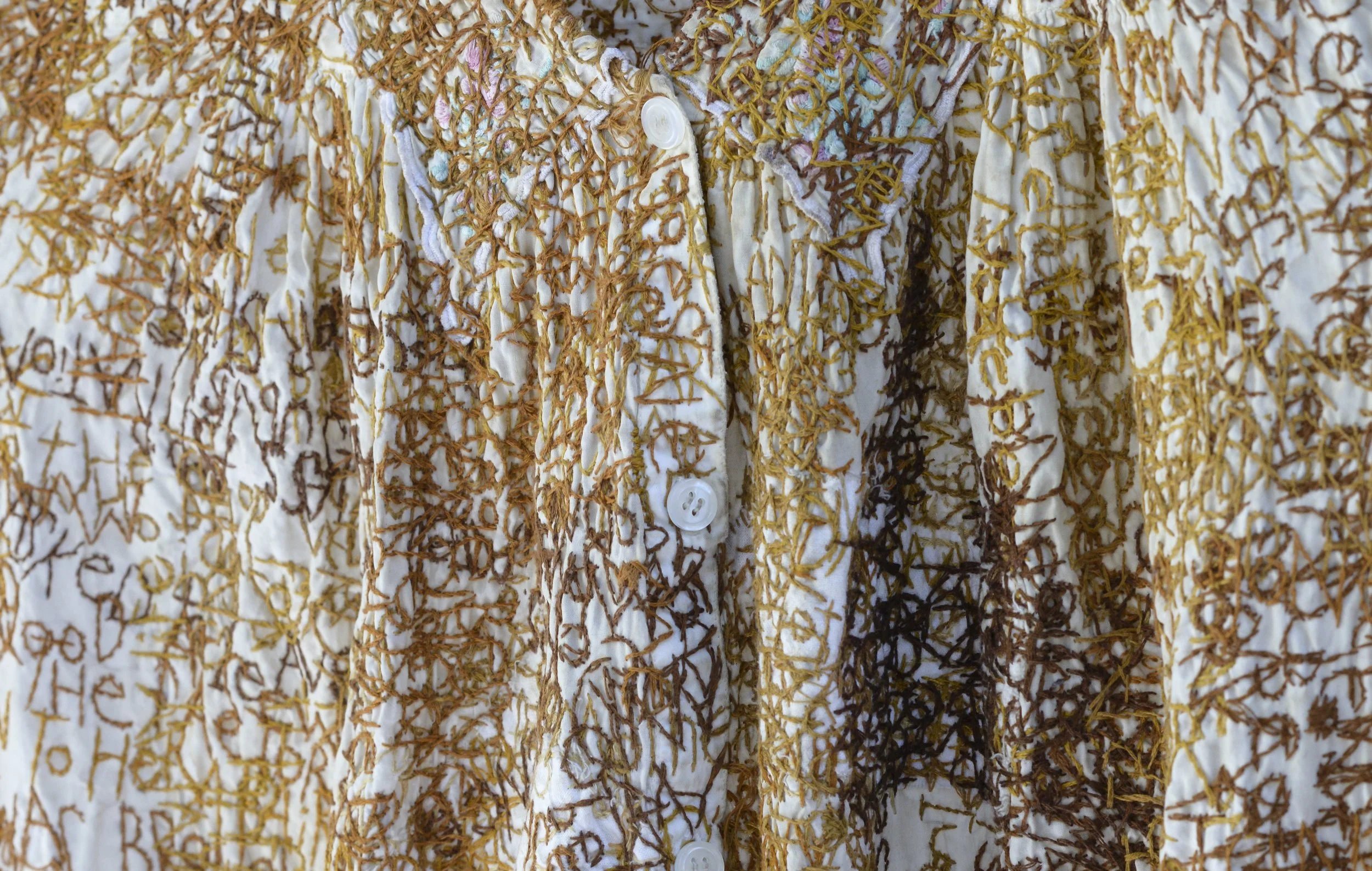
All these objects, fabrics or pieces of clothing have been used or worn by someone, lived in and animated by the previous owner. I manipulate the fabric and add weight and strength to what can often be a fragile material by layering thread, adding lace, embroidering text and staining the fabric. This is my version of storytelling, and an outward expression of an interior dialogue.
The process is slow and meditative - a reaction to the perfection of mass-produced, cheap, disposable goods. The work becomes an exploration of the time and intimacy of handiwork. I spend hours and months bent over a piece. As I stitch, I am further integrated into the work - sweat from my hands, a spot of blood from a pricked finger, a strand of hair that gets tangled into a piece of embroidery floss - are all literally incorporated into the textile.
Each tangled piece of thread is part of the memento mori, celebrating the complexity, messiness and ultimate decay of human life. I seek to explore the space between our individual and collective memories from the perspective of story and experience. I want to challenge our perception of the object, its worth and our memory of it. I’m creating repositories for our joys and sorrows; sculptures which summon ghosts and keep our stories
Karla Rydrych is a Minneapolis based textile designer. She comes from a long line of seamstresses, embroiderers and lacemakers, and has been actively creating for many years. She began making decorative art as a rug-hooker, designing patterns and dying the wool. Feeling bound in following the tradition of an established crafts, she started creating sculptural works often starting with muslin and utilizing vintage clothing and found objects. “I’ve gone to estate sales for many years and always felt moved being in someone’s space and seeing a lifetime of accumulation for sale. The suits and ties, and dresses and coats hanging in a closet were haunted by their former owners and had so much more to tell”.